The Real History Congress Hid from India: Assam’s Transformation By Keshaboina Sridhar
Congress’ Historical Betrayal of Assam and the North-East: A Detailed Analysis
The North-Eastern states of India — especially Assam — have long struggled with demographic changes, illegal migration, and geopolitical vulnerability.
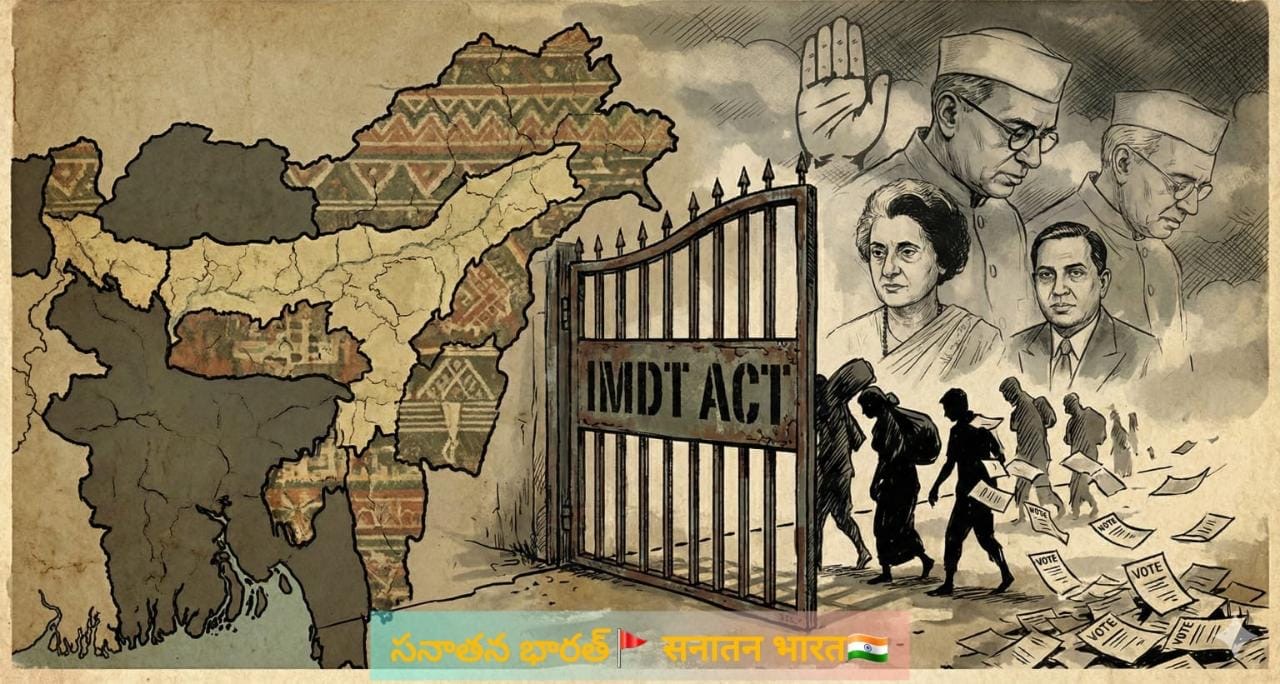 Contrary to the belief that these issues emerged recently, history shows that they are the direct result of decades of Congress’ vote-bank politics, strategic failures, and negligence.
This article presents a full chronological analysis of how Congress contributed to Assam’s demographic imbalance and weakened national security.
1. The Historic Blunder of 1939 – Opening the Door to Muslim League Influence
The roots of Assam’s demographic crisis trace back to 1939, when the Congress party resigned from provincial governments during World War II, protesting British policies.
This political vacuum allowed the Muslim League to form the government in Assam under the leadership of Muhammad Saadullah, famously called the “Jinnah of the North-East.”
Saadullah’s Dangerous ‘Cultivation Policy’
Once in power, Saadullah introduced a policy disguised as “agricultural expansion,” which in reality encouraged the large-scale migration of Bengali Muslim settlers from Bengal and Bihar into Assam.
Even British Viceroy Lord Wavell openly criticized this policy, stating:
“Saadullah is not cultivating land — he is cultivating Muslims.”
This marked the beginning of state-engineered demographic change, which Congress never attempted to correct.
2. Congress’ Shocking Decision: Adding Saadullah to the Constitution Drafting Committee
After Independence, Saadullah — a Muslim League leader who supported Partition and altered Assam’s demography — surprisingly did not move to Pakistan.
What is even more shocking is that the Congress leadership appointed him to the Constitution Drafting Committee.
This decision remains one of the biggest historical errors, as a person responsible for demographic change and communal politics was allowed to influence the framing of India’s Constitution.
3. The IMDT Act of 1983 – A Shield for Illegal Migrants
The problem of illegal immigration intensified after the 1971 Bangladesh Liberation War.
Instead of controlling illegal infiltration, the Congress government under Indira Gandhi introduced the Illegal Migrants (Determination by Tribunal) Act (IMDT) in 1983.
Why was the IMDT Act a disaster?
- The IMDT Act applied only to Assam, while the rest of India continued using the stricter Foreigners Act, 1946.
- Under IMDT, the burden of proving someone as an illegal migrant fell on the:
- government, or
- the complainant
— NOT on the accused. - A complainant had to live within 3 km of the alleged illegal migrant — a deliberately restrictive rule.
The result?
Between 1983–2005:
- Over 5 lakh illegal migrants were deported from the rest of India.
- But from Assam, only 1,500 could be deported.
Congress had effectively created a protective legal shield for illegal migrants, strengthening its vote-bank while endangering Assam’s identity.
4. Nehru’s Neglect and Weak National Security Posture
India’s first Prime Minister, Jawaharlal Nehru, made several miscalculations regarding the North-East:
During the 1962 Indo-China War
Nehru’s radio address saying
“My heart goes out to the people of Assam”
was widely interpreted as preparing to abandon Assam in the face of Chinese aggression.
Developmental Neglect
There are claims that:
- Nehru distrusted the North-Eastern people for their support to Subhash Chandra Bose during the freedom struggle.
- As a result, NECESSARY development and connectivity projects were delayed or ignored.
During Manmohan Singh’s government
Even in the 2000s, the Congress government failed to strengthen the region’s border infrastructure.
In 2013, Defence Minister A.K. Antony admitted in Parliament that India avoided building roads along the China border fearing it would “provoke China.”
This shows how Congress repeatedly compromised national security in the North-East.
5. Corrective Steps — After Decades of Damage
After decades of demographic and security damage, corrective action finally began:
The IMDT Act Was Struck Down in 2005
- BJP leader Sarbananda Sonowal, then a student leader, fought a landmark case in the Supreme Court.
- The Supreme Court declared the IMDT Act unconstitutional and a threat to national security.
During this case, Congress Chief Minister Tarun Gogoi even defended the IMDT Act, proving Congress’ stand in favor of illegal migrants.
Recent Strong Measures
Under the leadership of Chief Minister Himanta Biswa Sarma, Assam has initiated:
- strong anti-infiltration operations,
- eviction of illegal settlers,
- border strengthening, and
- demographic monitoring.
But reversing decades of damage is a long and challenging process.
Conclusion
Assam’s struggle with demographic imbalance, illegal migration, and security threats is not accidental — it is the direct outcome of historical decisions made by the Congress party.
From:
- allowing the Muslim League to alter Assam’s demography,
- appointing questionable leaders to the Constitution Drafting Committee,
- introducing the IMDT Act to protect illegal migrants,
- neglecting national security and border infrastructure,
Congress has repeatedly placed vote-bank politics above national interest.


Comments
Post a Comment